
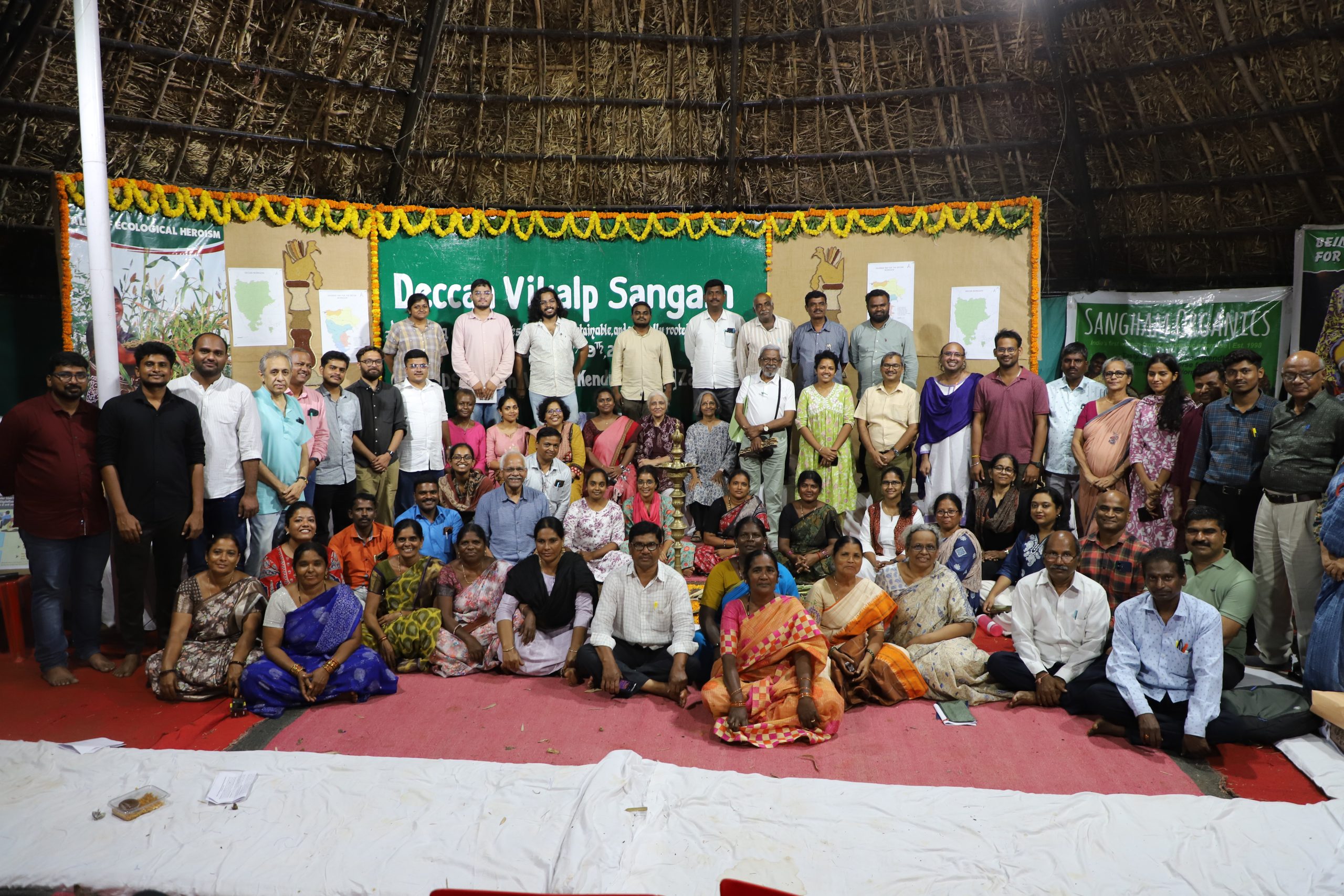
From 7th to 9th August, nearly 60 civil society organization members, community members, activists and academics working in the Deccan region came together for the Deccan Vikalp Sangam, a confluence for organizations and individuals working on development alternatives in the Deccan with bio-regional perspective, at the DDS-Krishi Vigyan Kendra campus at Didigi Village, Zahirabad madal, Telangana.
‘Vikalp Sangam’ (VS) is a confluence of organizations, groups and individuals, emerging out of a search for grounded alternatives to the current model of ‘development’ that is built on rising exploitation of both the environment and people. Vikalp Sangam (VS) in its General Assembly meeting, held in November 2024 at Kutch, decided to hold a Deccan Vikalp Sangam basically to engage with issues that are specific to Deccan bio-region. This Sangam aimed to bring together people and organizations across the Deccan bio-region who are taking the Alternatives movement forward in several thematic areas.


Two panel discussion on regional history were organized. In the first session titled “Syncretic Heritage and Living Culture in the Deccan” the participants included Prof Ganesh Devy (Bhaasha Institute) speaking on syncretism of deccan languages; Md Sibghat Khan (Deccan Archive) speaking on Karbala in medieval era; Salome Yesudas (Independent Nutrition Scientist) speaking on culture and agriculture; and Abhishek Patil (Living Labs Network) speaking on Sufi and Sharana movements. In the discussion on “Social Movements and articulations of resistance in Deccan History” the participants included Swathi Shivanand (Khidki Collective) speaking on the forgotten history of B Shyam Sunder’s Bhim Sena; Dheeraj Vanarasa (Independent historian) speaking on Language movment in Telugu regions of Nizam state; Harshavardhan Rathod (Living Labs Network) speaking on social movements in Kalyana Karnataka movement; Ravi Kanneganti speaking on history of Telangana’s peasant rebellionl and Dr Bharat Patankar speaking on overview of social movements of Deccan region. The discussions prompted interesting Q&A sessions among participants which enriched the collective understandings on the complexities in Deccan history.


On the second day, KJ Joy from Vikalp Sangam Facilitation Team presented on the flower of transformation framework of Vikalp Sangam. the participant broke into various thematic groups: Water, Food & Agriculture, Pastoralism & Livestock, Biodiversity & Ecology, and Arts, Craft & Culture. The water group was anchored by SOPPECOM (Maharashtra), Food & Agriculture by DDS (Telangana), Pastoralism & Livestock by WASSAN (Telangana team), Biodiversity & Ecology by ATREE (Eastern Ghats team), and Arts, Crafts & Culture by Living Labs Network (Karnataka). The groups discussed with some guiding questions that were focused on specific threats, best practices and way forward.


After lunch, the groups came together for a poster presentation with other participants. Firstly the Water group presented how decentralised water harvesting and governance mechanisms have been put in place in many states after decades of lobbying but the implementation/maintenance and equity within user groups is an ongoing struggle. They stressed that basin-level equity principle must be followed for watershed development projects, without disproportionately benefitting only those at the source or those only at valleys. Groundwater was also argued to be delinked from land ownership to be brought into commons regulations framework for both crop water budget and household allocation. They also highlighted practices in reviving few local forgotten water harvesting systems like Phad system (Maharashtra) and Karez system (Bidar).
 The Food & Agriculture group highlighted the historic neglect of rainfed agriculture in agricultural policy. While Deccan agriculture once largely consisted of local crops like millets and pulses, and mixed croppping was the norm in rainfed lands, policy decisions from many decades have steered small farmers in these regions to gamble with commercial monocrops, especially with hybrid seeds. In many regions, single monocops like sugarcane in maharashtra, paddy in telangana and groundnuts in rayalseema are being promoted among farmers amidst the loss of native crop biodiversity which is leading to erasure of local food cultures. The group also criticized the undue focus by governments on mega lift irrigation projects in the region that are unsustainable, at the cost of ignoring local knowledge in rainfed farming. They also highlighted the rising landlessness and need to focus on entitlements for tenant farmers.
The Biodiversity & Ecology group first stressed about how Deccan’s uniq ue biodiversity is often overlooked and misunderstood by policymakers. However, this was currently identified by many local communities (forest dwellers and rural) that have based their livelihoods on these resources and their relationship with their ecologies. However, many conservation projects, especially wildlife, are following a fortress conservation model that excludes people living there and neglects their knowledge on sustainable management of those resources. The group presented examples from participants NGOs on conservation models that integrated communities and livelihoods. Ensuring their rights to access is integral to any conservation project.
 The Pastoralism & Livestock group presented how land enclosures under industrialization are threatening common grazing lands and are disrupting traditional grazing routes of pastoralists. State lines are much different that the bio-regions of pastoralists. The lingering colonial perspective on pastures and grazing lands as ‘wastelands’ allows for counterintutive “green” projects like tree plantation, solar or wind farms on these lands, leading to more enclosures and disruptions. Quality of fodder is also reducing due to decreasing grass diversity, increasing invasive grasses and chemical agriculture with herbicides. Traditionally, livestock was a very integral component of dryland agriculture in deccan for its multiple functions (dairy, draught, manure and meat) and was also important for economic security of household in times of climate variability. The group also argued that current schemes to promote livestock in rural areas is still struck in a productivist paradigm in favour of stall-feeding sheds of non-native breeds at an etnerprise level, instead of focusing at the household level and respecting the dignity of livestock and its interlinked nature to ecology and agriculture. The group also highlighted how products from livestock like skin and wool were used to make important cultural goods like ‘dappu’ (hand drum) and ‘gongadi’ (blanket) by bahujan communities in the region.
 The group on Arts, Crafts & Culture demostrated how regional arts and crafts are determined by various factors like local ecology, material available, types of markets accessible, cultural diversity, patronage and predominant livelihood options. The shift from agro-pastoral livelihoods to industries, and mass production with plastic has led to decline of many local crafts. While certain crafts with expensive materials have survived with patronage as exotic niches, many popular crafts and folk arts have been ignored in several cultural preservation projects, or have even been appropriated by elite groups. They also acknowledge the upcoming threat of AI in accelerating such appropriation. Participants groups demonstrated their action research projects on preserving local knowledge systems and oral histories of local communities especially artisans, peasants and pastoralists.
On the third day, participants trailed along continuous field visits to various on-going programs at DDS. They first visited the biodiverse farm of Chandi Bai, village karykarta from Jamlai Thanda village sangham. Chandi Bai demonstrated how she grows nearly 26 varieties of crops which included 3 types of jowar, 2 types of foxtail millet, 3 types of pigeonpea, 2 types of sesame, 3 types of sorrel, 2 types of dolichoes, 2 types of cowpeas, 3 types of horsegram, pearl millet, barnyard millet, little millet, niger, greengram and blackgram, on a single plot. She also explained the importance of uncultivated greens and how these greens and crops together ensure her family has healthy food until the next year. After the field visit, participants visited DDS Campus and Millet Complex at Pastapur village where they interacted with staff members to know more about sangham activities and co-operative activities. Later, they visited the Central Seed Bank and Sangam Radio station at Pachasaale Campus in Machnoor village. The event concluded with an informal reflections session at the DDS-KVK campus.


